Client Session States
Introduction
RMR client session states control the behaviour of each rmr_clt_pool_sess and are critical
to data integrity. The state governs three things:
Map piggyback: dirty chunk IDs are piggybacked on write IOs for all sessions that are not in NORMAL state. Missing a piggyback entry causes a storage node to miss dirty tracking and can lead to data corruption on resync.
IO routing: IOs are only sent to sessions in NORMAL state. Sessions in any other state are skipped and their chunks are piggybacked instead.
Recovery sequencing: a non-sync session must pass through RECONNECTING and complete a map update before reaching NORMAL. Skipping this step risks enabling a storage node that has a stale dirty map.
All state transitions go through pool_sess_change_state(). The function enforces a strict
set of legal transitions and fires a WARN_ON for any illegal attempt. The only legal
transitions are shown in the diagram below.
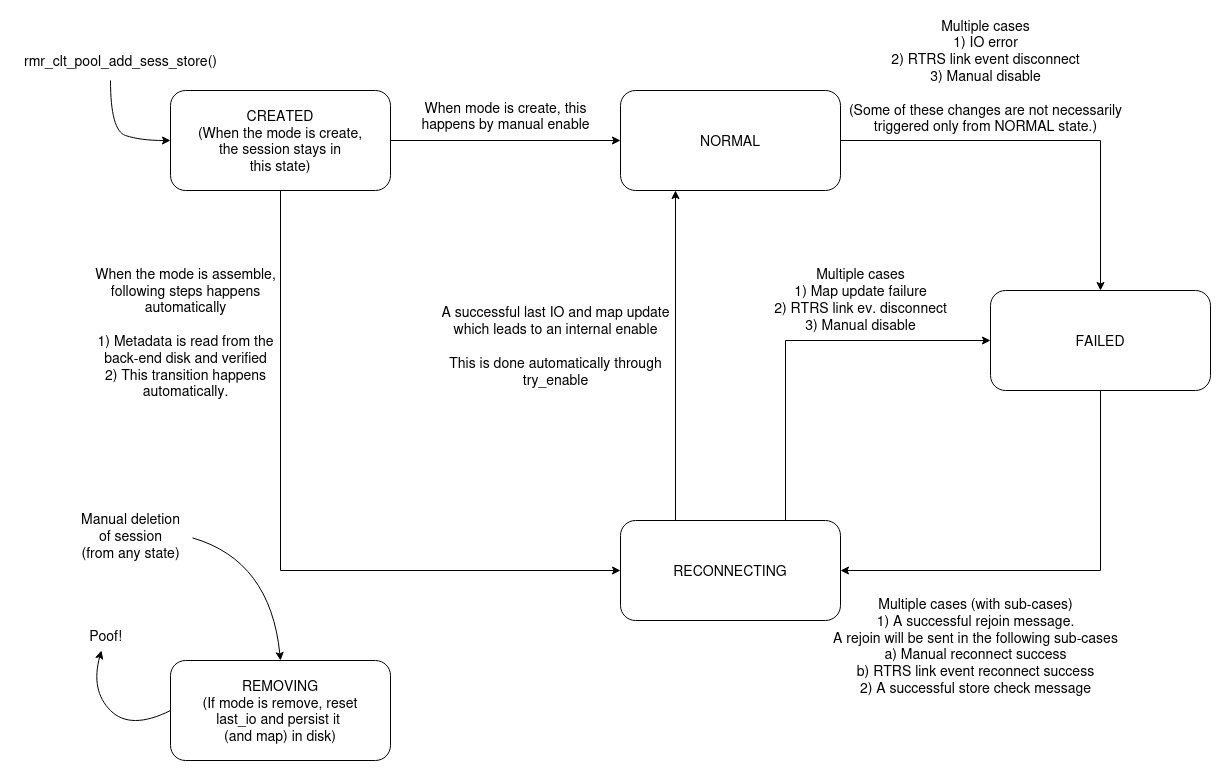
Note: the diagram needs updating to reflect the assemble/disassemble paths and maintenance mode transitions added after the initial design.
Legal transitions
From |
To |
Condition |
|---|---|---|
CREATED |
NORMAL |
Non-sync: manual enable via sysfs; sync: always |
CREATED |
RECONNECTING |
Non-sync assemble or reconnect path |
CREATED |
FAILED |
Link event or IO failure |
CREATED |
REMOVING |
del_sess called |
NORMAL |
FAILED |
Link event or IO failure |
NORMAL |
RECONNECTING |
Maintenance mode set ( |
NORMAL |
REMOVING |
del_sess called |
FAILED |
RECONNECTING |
Reconnect succeeded (non-sync only) |
FAILED |
NORMAL |
Reconnect succeeded (sync only) |
FAILED |
REMOVING |
del_sess called |
RECONNECTING |
NORMAL |
|
RECONNECTING |
FAILED |
Link event or IO failure |
RECONNECTING |
REMOVING |
del_sess called |
REMOVING is a terminal state: no exit transitions are permitted. Any attempt triggers
WARN_ON.
A non-sync session going directly from FAILED to NORMAL is an illegal transition and
triggers WARN_ON. It must pass through RECONNECTING so that a map update can occur first.
Sync sessions are exempt from this requirement because they do not participate in map
updates and go FAILED → NORMAL directly.
Pool recovery: rmr_clt_pool_try_enable()
Pool recovery is centralised in rmr_clt_pool_try_enable(). It is called automatically
whenever a session’s state changes in a way that could allow recovery to proceed:
After a successful store check (FAILED → RECONNECTING via
rmr_clt_handle_store_check_rsp)After a successful rejoin (FAILED → RECONNECTING via
rmr_clt_handle_rejoin_rsp)After maintenance mode is unset (
rmr_clt_unset_pool_sess_mm)After an assemble completes (
rmr_clt_process_non_sync_sess)Manually via the
pool_enablesysfs attribute at the pool level
The function acquires clt_pool_lock for its entire duration, serialising concurrent
recovery calls and preventing rmr_clt_open from racing with an in-progress recovery.
rmr_clt_open uses mutex_trylock and returns -EBUSY if recovery is running.
rmr_clt_close uses a blocking mutex_lock and waits for recovery to finish.
Recovery cases
Case 1 — ≥1 NORMAL session exists
The NORMAL session already has a complete, up-to-date dirty map. Freeze IOs, instruct the NORMAL session to send its map to every RECONNECTING (non-maintenance-mode) session, confirm each map receipt, then transition all RECONNECTING sessions to NORMAL and unfreeze IOs.
Case 2 — Exactly one was_last_authoritative RECONNECTING session
was_last_authoritative is set by pool_sess_change_state on the last non-sync session to
leave NORMAL state when the pool goes fully offline (i.e. when normal_count decrements to
zero). It is cleared when the session re-enters NORMAL state.
Because this session held the complete dirty map at the moment the pool went offline, it can
be enabled directly without receiving a map from another node. Send enable_pool(1) to the
server, transition the session to NORMAL, then spread its map to any other RECONNECTING
sessions exactly as in Case 1.
Cases 3/4 — All pool_md members present and RECONNECTING
No NORMAL session exists and no session carries was_last_authoritative (the pool went
offline before any session had a chance to set the flag, or all sessions failed
simultaneously). Run rmr_clt_start_last_io_update() to determine which storage node has
the most recent data, resync the divergent nodes, then transition all RECONNECTING sessions
to NORMAL.
If not all pool_md members are yet RECONNECTING (some are still FAILED or not yet assembled), the function returns without action and waits to be called again when the next session reaches RECONNECTING.
States
RMR_CLT_POOL_SESS_CREATED
A newly created (non-sync) session enters CREATED after a successful join_pool exchange
with the server. The session has a live RTRS connection but is not yet ready for IOs.
What happens next depends on the add_sess mode:
create mode: the session stays in CREATED. The user must manually write
1to the per-sessionenablesysfs entry. This sendsenable_pool(1)to the server and transitions the session to NORMAL.assemble mode:
rmr_clt_process_non_sync_sessreads the fullpool_mdfrom the server’s on-disk metadata, creates dirty maps for all known members, broadcasts aPOOL_INFO_ASSEMBLEto peers, then transitions the session to RECONNECTING and callsrmr_clt_pool_try_enable()to attempt immediate recovery.
A sync session skips both paths and goes directly to NORMAL after join_pool.
IO and command behaviour
No IOs are sent to this session. Dirty map entries are piggybacked for this member on IOs to other sessions. Command messages can be sent.
RMR_CLT_POOL_SESS_NORMAL
A non-sync session reaches NORMAL via one of:
Manual enable (create mode): user writes to the per-session
enablesysfs entry while the session is in CREATED state.rmr_clt_pool_try_enable()Case 1: a NORMAL session spread its map to this RECONNECTING session and confirmed receipt.rmr_clt_pool_try_enable()Case 2: this session carriedwas_last_authoritativeand was enabled directly.rmr_clt_pool_try_enable()Cases 3/4: all members were RECONNECTING; alast_io_updateresync completed.
A sync session reaches NORMAL after creation and again after a successful rejoin.
On every RECONNECTING → NORMAL transition was_last_authoritative is cleared.
IO and command behaviour
IOs are sent to this session. Dirty map entries are not piggybacked (the storage node is up to date). Command messages can be sent.
RMR_CLT_POOL_SESS_FAILED
A session enters FAILED when:
The RTRS link event reports a disconnect.
An IO to this session fails.
On every NORMAL → FAILED transition pool->map_ver is incremented so that in-flight IOs
carry the new version and the server can detect the change.
A FAILED session is excluded from IO routing. Its member ID is piggybacked on every write so that other storage nodes accumulate dirty entries on its behalf. Command messages cannot be sent because the RTRS connection is down.
When the RTRS connection is re-established, a store check is sent automatically. A
successful response triggers FAILED → RECONNECTING and calls rmr_clt_pool_try_enable().
IO and command behaviour
No IOs are sent. Dirty map entries are piggybacked for this member. No command messages can be sent.
RMR_CLT_POOL_SESS_RECONNECTING
A non-sync session enters RECONNECTING when:
A successful reconnect (store check response) arrives while the session is in FAILED or CREATED state.
The session was just created with
add_sess mode=assemble.A user manually writes
enable=0, which then sets maintenance mode on a non-REMOVING session (rmr_clt_set_pool_sess_mm).
Sync sessions must not enter RECONNECTING (enforced by WARN_ON in
pool_sess_change_state). Sync sessions do not participate in map updates; they go
FAILED → NORMAL directly.
A RECONNECTING session is still excluded from IO routing. Its member ID continues to be piggybacked on writes so dirty entries keep accumulating. Command messages can be sent, which is required for the MAP_READY / MAP_SEND / MAP_DONE exchange that happens during recovery.
Transition to NORMAL happens exclusively through rmr_clt_pool_try_enable(). There is no
manual map update path; calling pool_enable via sysfs invokes the same function.
Maintenance mode
Setting maintenance mode (enable=0 on a NORMAL session) transitions the session to
RECONNECTING with maintenance_mode=true. While in maintenance mode the session is
excluded from IO routing and from recovery: rmr_clt_pool_try_enable() skips
maintenance-mode sessions when scanning for candidates.
Clearing maintenance mode (enable=1) sends enable_pool(1) to the server, clears
maintenance_mode, and immediately calls rmr_clt_pool_try_enable(). If the session was
was_last_authoritative it is picked up as the Case 2 auth session; otherwise recovery
proceeds through Cases 1, 3, or 4 as normal.
IO and command behaviour
No IOs are sent. Dirty map entries are piggybacked for this member. Command messages can be sent.
RMR_CLT_POOL_SESS_REMOVING
A session enters REMOVING when del_sess is called, regardless of its current state.
REMOVING is a terminal state: pool_sess_change_state fires WARN_ON if any transition
out of REMOVING is attempted.
On entering REMOVING, IOs are frozen and the session is erased from stg_members so that
the IO piggyback loop stops referencing it. A leave_pool message is sent to the server.
Depending on the del_sess mode:
delete: the dirty map and
pool_md.srv_mdentry for this member are removed. The member is gone permanently.disassemble: the dirty map is preserved so that the piggyback loop on remaining sessions continues to accumulate dirty entries for this member until it reassembles. The
pool_md.srv_mdentry is also preserved so thatrmr_clt_pool_try_enable()can wait for this member on reassembly. If this was the last non-sync session, all maps are deleted (they will be recreated frompool_mdon the first assemble).
After the REMOVING state is reached the session object is freed.
IO and command behaviour
No IOs are sent.
No dirty map entries are piggybacked.
Command messages can be sent (for the leave_pool exchange).